Research Writing
Ch3. Time-Based Media
Time in Organic Life
The concept of temporality in art has always fascinated me, largely due to the ephemeral nature of time medium. First brought to the forefront of direct artistic manipulation and discussion by the moving image at the turn of the 20th century, concepts of time presented novel ways of dissecting reality that led to experimental means of artistic intervention. As the revolutionary excitements of the motion picture begins to fade away, the 21st century ushers in new forms of media that project new formations of time reality. Particularly, life has placed itself at the center of a new emerging and expanding art tradition, bringing the notion of time to untraveled grounds. This chapter advances the idea of the living organism as time-based media, and present a brief analysis of organic time based on a film time analysis model.
3.1 Time in the Moving Image
Time in film media can be understood on a variety of different levels and from different perspectives. In this paper, I would like to briefly put forth four points for consideration from the aspect of film theory and practice: 1) the notion of divided time, 2) the materialization of time, 3) the nature of inherent film time, and 4) the construct of meaning in film media.
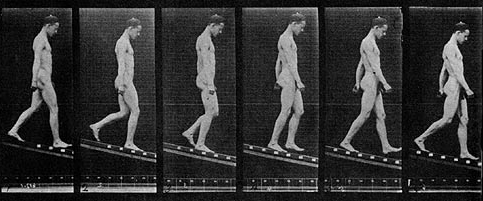
1) The Notion of Divided Time: In film, time is divided by and presented through frames. The frame captures what are considered crucial points of entry in constructing temporal flow and aids in understanding its manifestation in space. The result is a fragmented comprehension of the world, as illustrated in certain Cubist or Futurist works of art. The importance of clarity in the overall image is substituted by an amorphous impression of tendency that discloses in stages[73].
[73] Film sequence of athlete walking, Eadweard Muybridge, 1913
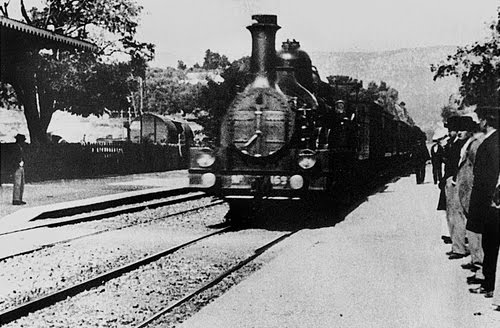
2) The Materialization of Time: Time in film is subject to manipulation that is unprecedented in the majority of preceding medias (with perhaps the exception of the audiotape). A big part of this is due to the recording of time on manipulative material. An interesting result to this advancement in technology is the capacity to reverse, speed up, slow down, cut up and re-sequence time in film. This “film time” (for lack of a better word) creates a parallel virtual temporal reality distinct from physical temporal reality that begins to presents possibilities of creating alternative worlds that are every bit as real as the predominant physical world as seen in the impact of the famous Arrival of a Train shot by the Lumiere Brothers on viewers at the turn of the century[74].
[74] Lumiere Brother's "Arrival of a Train"
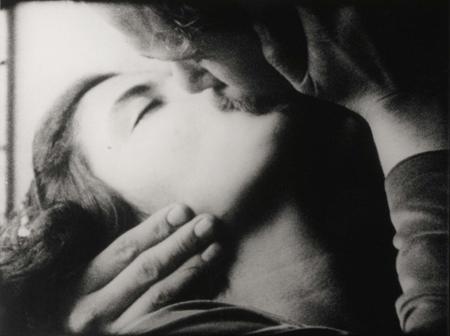
3) The Character of Inherent “Film Time”: Time in film has an internal scale that is determined by the frame rate, or number of frames per second (from hereon 29 referred to as fps). This is best exemplified by a series of experimental films Andy Warhol created. In standard film and television production, frame rate is either 24 – 25 or 29 – 30 fps. In Warhol’s piece Kiss[75], the frame rate was set to 16. This slight alteration, although not directly evident when viewing the film, is able to inspire an entirely different psychological reality within the viewer through the slowing down if inherent film speed.
[75] Andy Warhol's "Kiss"
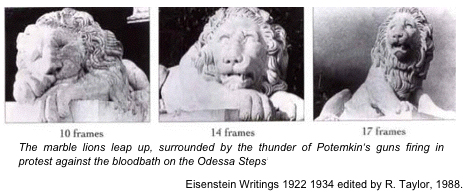
4) The Construct of Meaning in Film Media: Editing, also known as montage in some cases, is the core method of fabrication in film production. Through juxtaposition of images, sound, and narratives, meaning emerges. The Soviet filmmakers were pioneers in the art of editing and built the foundation for the theory of montage. Sergei Eisenstein is notably the most prominent figure in this domain. In his Battleship Potemkin, he effectively illustrates the construct of positive and negative meaning through different sequencing orders of three different stone lions: one crouched down, one sitting and one standing. By presenting the crouching lion first and the standing lion last, the viewer is able to interpret a clearly optimistic revolutionary message. By reversing that order, the negativity is instantly communicated[76]. Here, the relative time placement of clip sequences creates a semiotic relativity of meaning that communicates to the viewer.
[76] Film sequence of rising stone lion from "Battleship Potemkin", Sergei Eisenstein,
1925.
3.2 Time in the Living Organism
Before going into a structural analysis of time in life media, it is necessary to put forward my argument for categorizing organisms as time-based media.
In his book Mind and Nature, Gregory Bateson describes an exercise he assigned to his student. After presenting the class with a crab, he asked the students to explain how they knew the crab had once been alive. Similarly, in a class I took with 30 eco artist Jacklyn Brookner, we were shown an assortment of objects ranging from potted plants to sea shells, to iron sculptures, to pebbles from a bank, and asked to identify which were natural, which were artificial and how we knew. What struck me was my experience with two objects. One was an old lock that was clearly artificially made, but was worn by nature over time. The other was a piece of brick that most of us thought originally was a rock because its corners had been worn out so much (perhaps by water) that it was unidentifiable as an artifact.
There is an innate sense of time implied through organic form. Organic forms demonstrate tendency and “growth” (for lack of a better word), a process that extends over time. The geometric design of the worn out lock, though uneven due to inaccuracies in handcrafting, resembles only a moment in time. Contrarily, the wear and tear of the lock due to sustained exposure to environment presents an organic quality to the artifact and indicates process over extended duration.
As Bateson writes in his book:
A man wanted to know about mind, not in nature, but in his private large computer. He asked it (no doubt in his best Fortran), “Do you compute that you will ever think like a human being?” The machine then set to work to analyze it’s own computational habits. Finally, the machine printed its answer on a piece of paper, as such machines do. The man ran to get the answer and found, neatly typed, the words: THAT REMINDS ME OF A STORY[77]
[77] Bateson, Gregory, Mind and Nature: A Necessary Unity. New York: Bantam Books Inc., 1980.
This very narrative quality suggests the temporality of our own existence. Therefore, it is my belief that it is also possible to question the notion of time within biological organisms.
Following the model of thought articulated in the previous section, the notion of time can begin to be addressed through four points: 1) the notion of the two-dimensional time, 2) the materialization of time, 3) the character of inherent biological time and 4) the construction of meaning in living organisms.
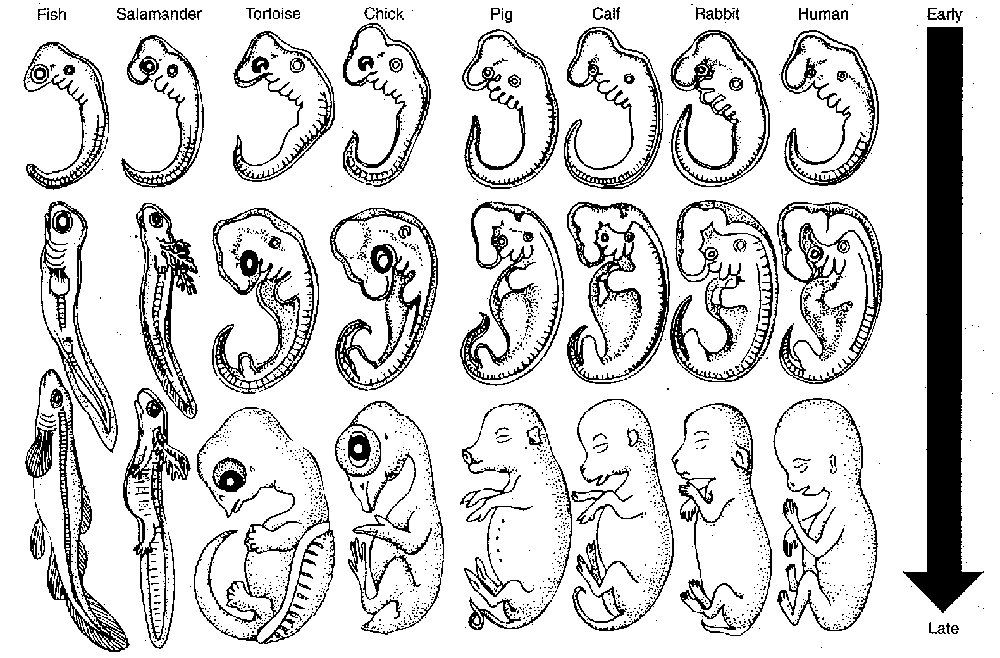
1) The Notion of Two-Dimensional Time: If we compare [73] with Figure [78], we can easily identify that the former emerges on a single x axis while the later has both an x axis and a y axis (individual evolution and interspecies evolution). Time within a biological framework is two-dimensional, expressed in the form of growth (be it individual or group), and mutation (a temporal drifting between species).
[78] Comparison of early embryonic stages across vertebrate groups, Ernst Haeckel
2) The Materialization of Time: A major difference between materialization of biological time and film time is virtual and physical. Whereas film presents a twodimensional image of time, organisms are themselves living moments of time, time in the form of concrete three-dimensional entities. If the moving image represents time through expanding into flat spatial planes over duration (and this includes the notion of movement), then organic life (or even what is perceived as non-organic life, such as geological shifts) is time extending into three-dimensional space. Needless to say, the manipulation of time on the biological (or possibly geological) level is a recreation of actual physical reality (the term actual physical reality is by no means indicating that physical reality is true reality).
3) The Character of Inherent Biological Time: Inherent biological time refers to what is called the biological clock, which is an underlying part of the single organism’s perceptive system. Inherent time in the organism provides the scale on 32 which psychological reality of the organism (if organisms have psyche) can be generated. When growing silkworms, time plays a crucial role in the determination of worm’s cycle. Worms hatched in the beginning of April grow larger and have longer cycles than worms hatched in the beginning of May. This method, of course, is a simple and perhaps crude means of time manipulation in life forms. But if we consider the rapid developmental speed of current biotechnologies, there may very well be technologies in the near future that can change the “frame rate” of living beings. Though it is near impossible (or is it?) to understand the internal reality of a worm, or a sheep or dog, one can only speculate upon the possible change it brings to the organism and the alternative realities it may generate.
4) The Construction of Meaning? To consider time within life on an even larger scale, ideas of de-extinction brought forth by books such as Regenesis[79][80] suggest possibilities and realities of bringing back extinct species. These choices are made by a small group of scientists who base their argument on what may be perceived as perhaps simplistic moral grounds of wildlife protection and bio-diversity. One can only wonder what this shift of relative time between species can mean to the future. The intervention into life on drastically different timescales is still a new practice, and the meaning behind such actions are still vague and uncertain. For this reason, artists and designers have become increasingly interested in experimenting with related materials and techniques. Therefore, I believe it is also increasingly important to question the meaning behind these points of entry and these interventions.
[79] Church, George M. and Ed Regis, Regenesis: How Synthetic Biology will Reinvent Nature and Ourselves. Basic Books. October 2012.
It is necessary it say that the point of this thought exercise is not to bury oneself in non-ending ethical discussions over the morality of biotechnology (at least not yet, that will come in due time), but rather to pose open-ended questions from an aesthetic point of view that may possibly aid in thinking about the role of the designer and artist (and a difference in relationship to a scientist and technologist, if there is a difference) in the face of advanced sciences, technologies and even life itself, and to question the relationship between maker and makee within this new context.
These issues and questions have continued to play a guiding role in my own practice for the past year. The prospect of creating hybrid systems between technology and organic life has led me to consider the drastically different time scales on which technology and organic life belong. The evolution of technology has always seemed to develop towards speed and efficiency, while biology itself has for the most part, sustained a relatively slower time frame. My interest lays not so much in the optimization of the organism, but of finding points of negotiation within these varying time scales, and the variations of this negotiation becomes the artwork itself.
Bibliography
Bateson, Gregory, Mind and Nature: A Necessary Unity. New York: Bantam Books Inc., 1980.
Haeckel, Ernst, Art Forms in Nature. Munich, London, New York: Prestel Verlag, 1998.
Church, George M. and Ed Regis, Regenesis: How Synthetic Biology will Reinvent Nature and Ourselves. Basic Books. October 2012.